Glute Bridge
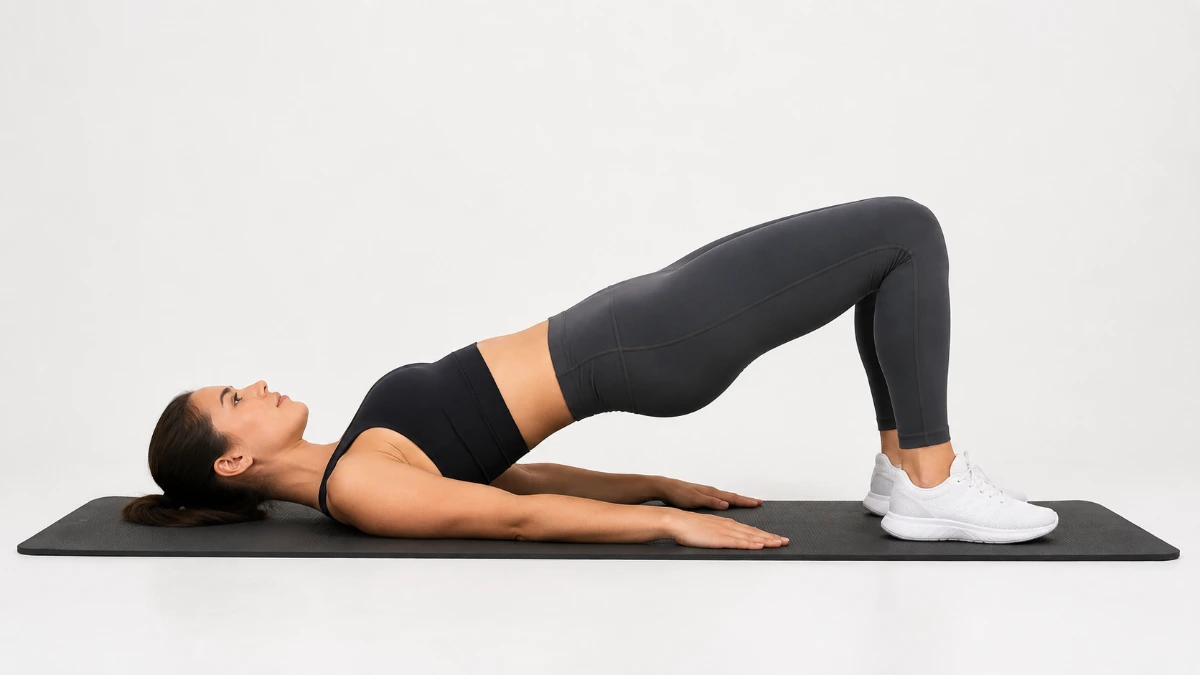
The glute bridge is a beginner-friendly strengthening exercise that targets the glute muscles while also engaging the hamstrings and core.
Exercise Overview
| Detail | Information |
|---|---|
| Difficulty | Beginner |
| Equipment | None |
| Primary Muscles | Gluteus maximus |
| Secondary Muscles | Hamstrings, core |
| Exercise Type | Strength |
| Body Area | Lower body |
| Category | Strength Exercises |
Purpose
The glute bridge strengthens the muscles responsible for hip extension, particularly the glutes. It is useful for developing lower-body strength and improving control of hip movement.
Target Muscles
Primary
- Gluteus maximus
Secondary
- Hamstrings
- Gluteus medius
- Abdominal and trunk muscles
Difficulty
Beginner
The basic glute bridge requires no equipment and can be performed on the floor, making it a good starting exercise before progressing to more demanding hip-strengthening exercises.
Equipment
None
Optional later progressions can use resistance bands, dumbbells, or other external resistance.
How to Do a Glute Bridge
- Lie on your back with your knees bent and feet flat on the floor.
- Place your feet approximately hip-width apart.
- Keep your arms relaxed beside your body.
- Brace your core gently.
- Press your feet into the floor and squeeze your glutes.
- Lift your hips until your shoulders, hips, and knees form a comfortable straight line.
- Pause briefly at the top without excessively arching your lower back.
- Lower your hips slowly and with control.
- Repeat for the desired number of repetitions.
Key cue:
Squeeze your glutes and lift your hips rather than trying to arch your lower back.
Common Mistakes
Overarching the lower back
Avoid lifting the hips by excessively extending the lumbar spine.
Pushing mainly through the toes
Keep the feet firmly grounded and drive through the whole foot.
Knees falling inward
Keep your knees tracking generally in line with your feet.
Moving too quickly
Use controlled movement rather than bouncing the hips.
Lifting too high
You don’t need to push the hips excessively upward. Focus on controlled hip extension and glute contraction.
Progressions
Once the basic glute bridge becomes easy, you can progress by changing the resistance, stability, or movement demands.
Progressions include:
- Banded glute bridge
- Weighted glute bridge
- Longer pause at the top
- Single-leg glute bridge
- Feet-elevated glute bridge
- Hip thrust
Regressions
If the standard glute bridge is difficult, start with a simpler variation:
- Short-range glute bridge
- Isometric glute squeeze
- Assisted glute bridge
- Reduced-repetition glute bridge
Focus on learning controlled hip movement before increasing repetitions or resistance.
Benefits
Regularly practicing glute bridges can help:
- Strengthen the glute muscles
- Improve hip-extension strength
- Develop lower-body muscular endurance
- Improve control of pelvic and hip movement
- Provide a foundation for more advanced hip-strengthening exercises
Contraindications & Precautions
The glute bridge is generally accessible, but pain is a reason to modify or stop the exercise rather than push through it.
Use additional caution or seek professional guidance if:
- The movement causes or significantly increases pain.
- You have a recent hip, pelvic, or spinal injury.
- You have been advised to restrict certain movements or loading.
- You cannot perform the movement comfortably despite reducing the range or repetitions.
Related Workouts
This section will eventually connect the exercise to actual MovePedia workout posts.
For now:
Related Workouts
- Beginner Lower Body Strength
- Glute Strength Workout
- Full Body Strength Workout
- Lower Body Strength & Mobility